
U.S. Naval Institute editor shares why Chinese naval expansion shouldn't be underestimated
China’s rising maritime power is not to be underestimated, a former naval intelligence officer told attendees at the March 11 meeting of the National Press Club's affiliated American Legion Post 20.
“Right now we have a global strategic adversary that is very much intent on building sea power,” Capt. Bill Hamblet, U.S. Navy, retired, and editor-in-chief of Proceedings, the magazine of the United States Naval Institute, told in-person and online attendees over brunch in the Club’s McClendon Room.
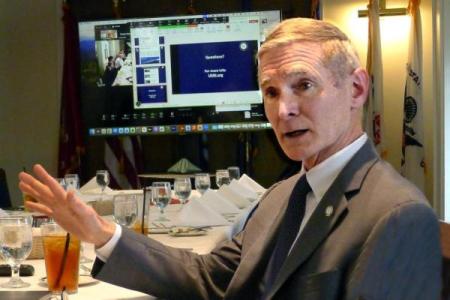
He shared a detailed presentation that highlighted many emerging threats on the U.S. Navy’s radar, and provided insights into China’s naval capabilities, such as its first supercarrier, the Type 003 Fujian. He explained that China’s capacity to project maritime power across vast geographical distances is not something to observe only casually.
“They have sent their ships over to the Red Sea, the Persian Gulf, the Mediterranean. They’ve had ships all the way up in the Baltic. They’ve sent ships up through the Bering Strait. They’ve had them off the coast between Hawaii and California,” he said.
“As they have grown and built their navy and made it more blue-water capable, they’ve been expanding their operations.”
Drawing on his previous 29 years of active duty, Hamblet gave sharp insights into current strategic debates regarding U.S. shipbuilding, maritime force projection, and potential naval threats posed by China and Russia.
In response to questions regarding increased Chinese activities in the Arctic region, Hamblet said that China is seeking to expand its influence and explore new maritime routes for trade.
“They’re participating in all of these Arctic forums. They’re not even an Arctic nation,” he said. He said he doesn't regard this as an immediate threat, but added that the U.S. Navy is concerned about China using ballistic missile submarines to “deploy through the Bering Strait up under the ice like the Soviets and now the Russian Navy does.”
He said the U.S. military is keeping a steady eye on this.
“The U.S. should have a bigger presence in the Arctic,” Hamblet said. “Maritime domain awareness is a big part of that. What’s up there? Can we track it? Do we know it’s there? Do we have a good way of keeping eyes on what’s up there?”
Asked whether persistent delays in the U.S. Navy’s Columbia-class submarine program should concern American citizens, Hamblet said he believes that delays in producing the first ship of every class are normal and that he believes the Navy has already quickly overcome many supply chain challenges it faced in shipbuilding over the past decade.
“They’ve resolved a lot of those problems,” he said. “You can’t take your foot off the gas, but I think the problems have been addressed and we’re making progress.”