
Sanders takes aim at Trump, mainstream Democrats, corporate media in remarks
Sen. Bernie Sanders made an impassioned plea for electing Maine Democrat Graham Platner to the U.S. Senate, dismissing questions about some of Platner's alleged violent interactions with former girlfriends as a byproduct of traumatic military service.
During a 48-minute Headliners event appearance at the National Press Club June 8, the Vermont independent observed that Platner “served four terms in Iraq and Afghanistan … he came back home with serious problems,” but has since married someone “nice” and sought treatment from the U.S. Department of Veterans Affairs for his post-traumatic stress disorder.
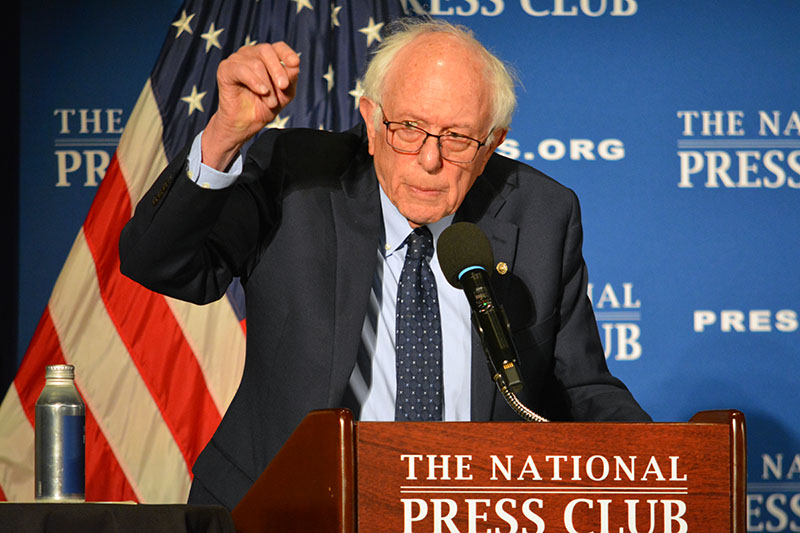
Sanders, who was interviewed for the Headliners Coffee & Conversation late afternoon event by "CBS News Sunday Morning" national correspondent Robert Costa, also implied that voting in favor of tax cuts for the wealthy is in the same category as domestic violence.
“There are people in the United States Senate right now who are not saints, I can tell you that,” Sanders said.
Platner, who shot to fame as an appealing working class Democrat who touts his own economic struggles as a way of resonating with voters, was favored to win the Maine primary Tuesday, June 9, setting him up for a general election showdown with incumbent Republican Sen. Susan Collins, who has held the seat for 29 years.
However, a lengthy story in The New York Times last week raised questions about Platner's temperament and treatment of women, with some women reporting that he could be verbally abusive and ominously physical with them.
At least one of the accusers is a right-wing political operative. Platner has denied most of the specific claims.
Sanders said the whole thing is a political smokescreen.
“Republican super PACS want to defeat him,” said Sanders of Platner, adding “He is going to be a strong voice against oligarchy.”
Sanders, who said most of his priorities are rarely covered by the “corporate media” (and he gestured up at the assembled reporters), declined to offer any details about his most recent big proposal, which would create a sovereign wealth fund to take more than 50 percent control of the big AI companies.
The fund, which he said is modeled on Norway’s creation of a national fund of assets supported by that country’s oil wealth, would probably be controlled by presidential appointees confirmed by the Senate, like judges or Cabinet members.
Recently, Sanders has refocused his energy on artificial intelligence and its far-ranging impact on the environment, water supply and energy consumption as well as broader issues about who owns the intellectual property that the systems are built upon.
Sanders notes that people who send Tweets, like he often does, are providing raw material for many AI models, which vacuum up everything on the Internet.
Sanders and Rep. Alexandria Ocasio-Cortez, D-N.Y., introduced the Artificial Intelligence Data Center Moratorium Act, which proposes a nationwide pause on the construction of new AI data centers until strong federal safeguards are written and implemented.
Sanders said he worries about children who are best friends with AI bots.
There were multiple interruptions by protestors during Sander’s remarks, all focused on Israel’s treatment of Gaza, though he pointed out that he’s been very critical of Israel’s actions there.
“The United States should not be funding the Israeli military…Our policy towards the Middle East needs some fundamental changes.”
He expressed dissatisfaction with the majority of Democrats who want to replace Trump, dismissing “establishment Democrats” because they don’t know how to practice “grassroots politics” in an authentic way, as Zohran Mamdani did by getting elected mayor of New York City.
“We could do it not just in large cities like New York, but you can do it in rural areas all over this country. People understand that the system is broken. It is rigged. It is corrupt,” Sanders said, adding that mainstream Democrats “gotta do more.”
Costa asked Sanders 10 questions, covering everything from Pope Leo XIV (Sanders is a big fan) to first lady Melania Trump (Sanders is not a fan) while providing the Vermont senator with largely predictable openings on his favorite topics -- including his admiration for Eugene Debs, a trade unionist and socialist from Indiana who is Sanders’ role model.
Sanders went on an extended soliloquy about Debs, reminiscing about a time in the 1970’s when he produced an informational video about him in response to an encounter with University of Vermont students who knew nothing about him. Sanders said he went out to Indiana to do original research about Debs as a way of creating an introduction to his life and times.
“This was an extraordinary man," Sanders said. "He certainly was one of the great Americans in our history."