
New exhibit highlights press freedom values at the core of Pentagon press corps walkout
The National Press Club has opened a new library exhibit honoring the Pentagon press corps — a group of journalists whose work is essential to the country’s understanding of its military and national security decisions.
On Oct. 15, dozens of credentialed reporters were ordered to surrender their access to the Pentagon after refusing to sign new government-issued documents that would have required them to accept restricted movement, unequal access, and to report only information deemed “authorized for public release.” The move was a sweeping break with long-standing norms of openness and equal treatment for the press.
When journalists declined to sign the conditions, they were told to turn in their badges and to clear out their long-standing workspaces.
The library exhibit, which features a variety of the items those journalists were able to carry from their workspaces on Oct. 15, is one of several ways the National Press Club is spotlighting and supporting the Pentagon Press Corps in its fight for access and overarching press freedom values.
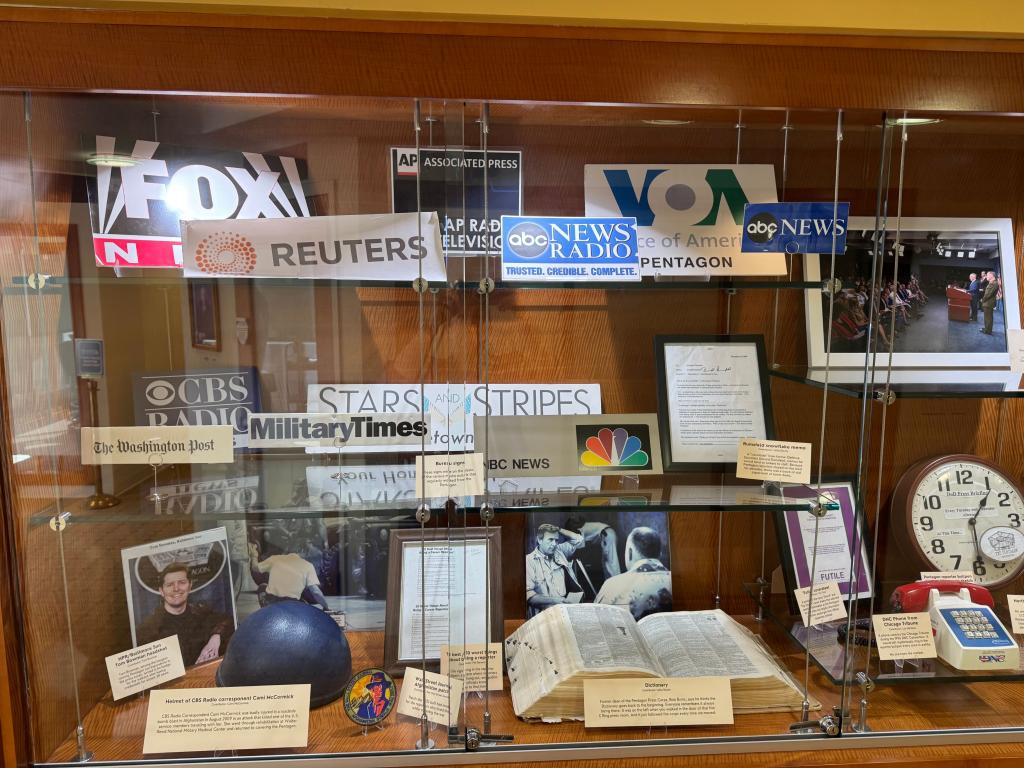
“This exhibit is a record of that moment,” NPC President Mike Balsamo said during the exhibit’s opening reception on Nov. 13. “It captures the sweep of what happened and the resolve of those who lived through it. It honors the reporters who refused conditions that violated the basic principles of journalism.
“And it reminds the country that independent reporting on the military is not optional — it is a safeguard of democratic accountability.”
Dozens of Pentagon reporters mingled during the reception and expressed gratitude for the Club’s continued support, which has included:
- The Club’s advocacy campaign designed to keep the issue in the national conversation: a public statement, engaging on social media, briefing partner organizations, and ensuring the story stayed visible in newsrooms and among policymakers.
- The Club provided a trusted space where journalists could gather, strategize, and support one another. Within the Club’s historic walls, reporters, newsroom leaders, and legal teams met to coordinate their response and chart a path forward.
“When the government begins saying, ‘You may report only what we approve,’ and removes those who decline, that is not access policy — that is a threat to democratic oversight,” Balsamo told the Pentagon reporters. “And when the most powerful military in the world decides who gets to witness its actions, the public loses the transparency it depends on.”
Club members may visit the exhibit during library hours, 8 a.m. to 8 p.m. Monday through Friday. Some exhibit items include:
- Bureau signs from news organizations that previously had regular workspaces in the Pentagon
- The Pentagon reporter bullpen clock
- The helmet belonging to CBS Radio Correspondent Cami McCormick, who was badly injured in a roadside bomb blast in Afghanistan in August 2009 and who returned to covering the Pentagon after recovering
- A "snowflake" from former Defense Sec. Donald Rumsfeld, memos he would send as taskers to staff
- A parody of the many "Secret" and "Top Secret" cover sheets that adorned sensitive information at the Pentagon
Washington Post Pentagon correspondent Tara Copp, who serves on the Club’s Board of Governors, worked closely with the National Press Club Journalism Institute staff to coordinate the exhibit and reception.
Beth Francesco is the executive director of the National Press Club Journalism Institute.