
Leader accuses China of ‘trying to eliminate Tibetan identity’
Tibetan government-in-exile leader Penpa Tsering appealed to the global community last week to support the region, asserting that the Chinese government is orchestrating a calculated obliteration of Tibetan identity through pervasive suppression and cultural dismantlement.
“They are trying to eliminate Tibetan identity altogether,” Tsering said during a National Press Club Headliners event on Oct. 29. “This is not just a human rights issue. It is a question of the survival of a people.”
Tsering, who holds the title of Sikyong — the executive head of the Central Tibetan Administration — addressed a room of journalists, diplomats and human rights advocates, outlining what he described as a methodical campaign by the Chinese Communist Party to extinguish Tibetan language, spiritual practice and ancestral lifeways.
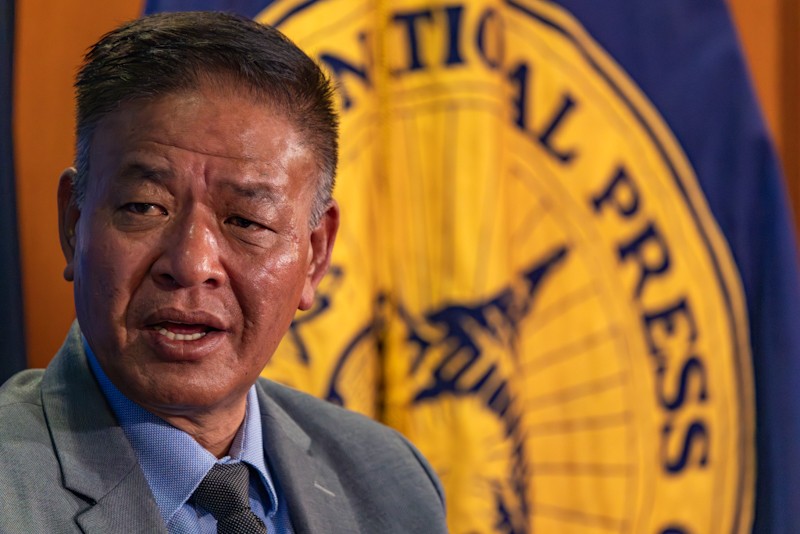
Over the course of the hour-long dialogue, Tsering described the razing of monasteries, displacement of nomadic clans, and the mass conscription of children into state-controlled boarding institutions.
“More than one million Tibetan children have been taken from their homes,” he said. “They’re being taught to worship the Communist Party and forget their own language, their own traditions. This is not education. This is indoctrination.”
Tsering’s visit to Washington coincides with a pivotal juncture for Tibet as the Dalai Lama nears his 90th year. The question of spiritual succession looms large, and Tsering warned that Beijing intends to commandeer the process, a move he said would desecrate centuries of sacred tradition.
“The Chinese government wants to appoint the next Dalai Lama,” he said. “That is unacceptable. The reincarnation of the Dalai Lama is a spiritual matter, not a political one.”
He recounted the ordeal of Namkyi, a 15-year-old Tibetan girl who was incarcerated for displaying a poster of the Dalai Lama. After enduring years of surveillance and intimidation, she escaped China. Her story, recently spotlighted by United Nations human rights experts, exemplifies the peril faced by Tibetans who express religious fidelity or dissent.
“Namkyi’s story is not an exception. It is the rule,” Tsering said. “Tibetans are criminalized for expressing their faith, for speaking their language, for simply being Tibetan.”
Beyond cultural and religious repression, Tsering raised alarms about ecological degradation on the Tibetan Plateau, a region he referred to as the “Third Pole” due to its immense freshwater reserves. He said China’s aggressive dam construction and mineral extraction imperil not only Tibet’s delicate biosphere, but also the water security of nearly two billion people across Asia.
“What happens in Tibet does not stay in Tibet,” he said. “The rivers that originate in Tibet feed the lives of people from Pakistan to Vietnam.”
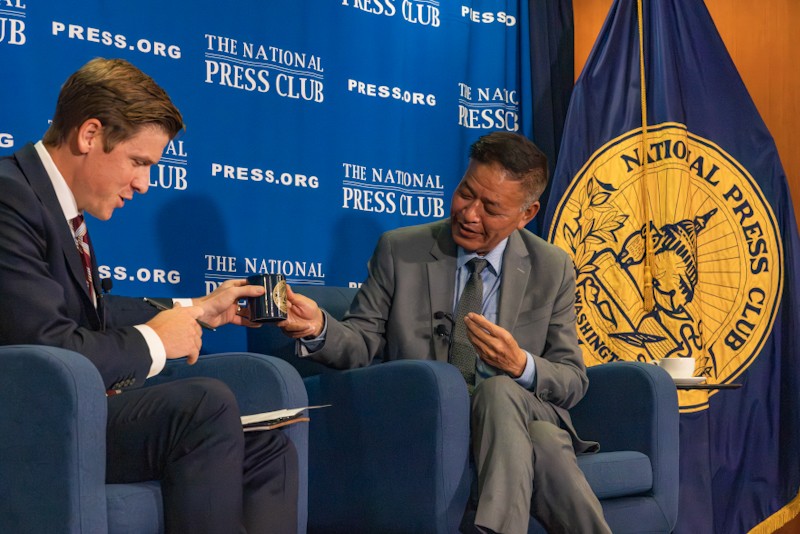
Tsering implored the United States and its allies to uphold the Tibetan Policy and Support Act of 2020, which affirms the rights of the Tibetan people and safeguards the Dalai Lama’s succession from Chinese interference. He also urged members of the press to amplify Tibetan narratives and counteract Beijing’s disinformation.
“We need your pens, your cameras, your platforms,” he said. “The truth must be louder than propaganda.”
Born in a refugee enclave in southern India, Tsering has devoted his life to championing Tibetan autonomy. Before ascending to the role of Sikyong in 2021, he served as speaker of the Tibetan Parliament-in-Exile and as the Dalai Lama’s emissary in North America.
“This is not just about Tibet,” Tsering said. “It is about the values we all claim to uphold — freedom, dignity, and justice. If we abandon Tibet, we abandon those values.”