
December in Club history: Harding, Pyle, Pearl Harbor
Dip down anywhere in the National Press Club’s 117-year history and we find remarkable stories about events at our Club that contributed to American, world and social history. The Club’s History and Heritage Team is highlighting just a few each month so our members can appreciate the role the Club has played for well over a century as the place where news happens. Here are December’s contributions, which completes a full year.
Dec. 15, 1921: President Harding, active Club member
Before he entered politics, Warren Harding was the publisher of the Marion (Ohio) Star. In fact, the 1920 election pitted Harding against James M. Cox, the publisher of the Dayton (Ohio) Daily News. Whoever won, a journalist would be president.
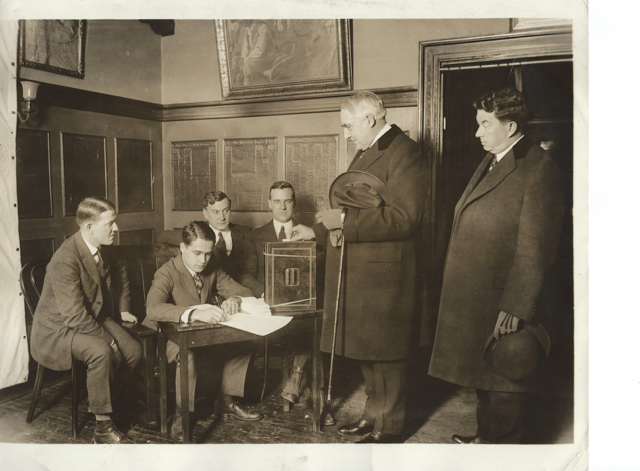
Harding signed up as a Club member after arriving in D.C. as a senator in 1915. As the Club’s 1928 history said, “before entering the White House, and in the period following, Mr. Harding was a frequent visitor to the Clubhouse, for he liked to hobnob with those whom he liked to call his cronies in the writing field.”
Harding voted in at least one Club election, and the photo of him casting his ballot in the Dec. 15 election is one of the Club’s treasures. The Club threw a dinner in his honor to mark the first anniversary of his administration.
Harding also was known to enjoy a game of poker. How much he played with his fellow members is up for speculation.
Dec. 7, 1941: Pearl Harbor Day at the Club
In the 1940s, the Club was open seven days a week, although on Sundays it was sparsely populated. On this particular Sunday, the weather was warm and the crowds were at Griffith Stadium to watch the Redskins play their last game of the season.
Shortly after 2:35 p.m., President Roosevelt’s press secretary Steve Early (and Club member) arranged a conference call with the wire services. “This is Steve Early at the White House. At 7:35 a.m. Hawaiian time, the Japanese bombed Pearl Harbor. The attacks are continuing – no, I don’t know how many are dead.”
According to the Club’s 1958 history, Shrdlu, “By some telepathy, the idea seemed to spread that reporters should report to the Club. From their homes, from wherever they had been, newspapermen converged on the Club until the rooms were crowded, everyone seeking fuller information, speculating on the next step in prospect of fighting a new war which was to come apace.”
By early Sunday evening, the crowd had grown to Election Night size, Lyle Wilson, United Press’ Bureau Manager wrote in the Club’s 1948 History, Dateline Washington. “Newsmen caught in the of crisis sought one another’s company, one another’s information and opinion, and perhaps one another’s comfort in the easy-going headquarters where they were accustomed to find these things. But there were no election-night gaieties.”
Dec. 4, 1944: Ernie Pyle’s brief Club membership
Ernie Pyle is one of the greatest names in newspaper reporting history. His Pulitzer Prize-winning work in capturing the stories of front-line troops as they slogged through Europe on their way to Berlin are legendary. Even today, stories and books about Pyle are widely read.
But was he a Club member?
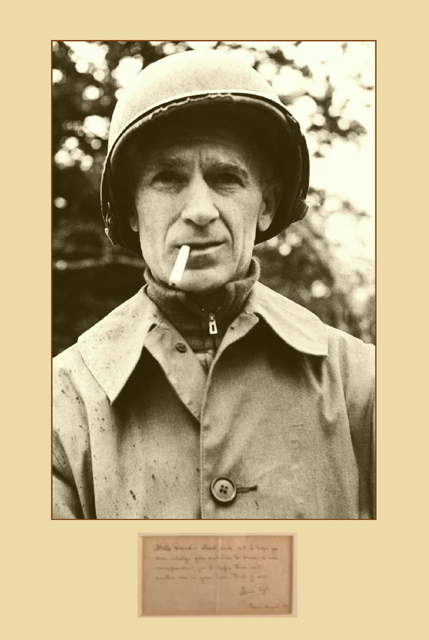
A search through membership lists from the 1920s and 1930s when he worked in Washington did not find him. But in researching a book on WWII correspondents, History & Heritage member Noel-Marie Fletcher found reference to Pyle’s Club membership.
With a targeted timeframe in hand, Club Archivist Jeff Schlosberg pulled out the Club Board minutes from late 1944 and early 1945. There he found that Ernie Pyle was proposed for membership as a nonresident member at the Dec. 4 meeting by Thomas L. Stokes of the United Features Syndicate and John T. O’Rourke, the editor of The Washington Daily News. He was elected to membership at the Jan. 2 board meeting.
This was during the brief time Pyle was in the United States between the fall of Berlin and heading to the Pacific. He was killed on April 18 by a Japanese sniper on the island of le Shima during the Battle of Okinawa, after being a member for just 14 weeks.
A Club tribute to Pyle is outside the Fourth Estate dining room.
Dec. 19, 1956: Jawaharial Nehru addresses the Club
India’s first Prime Minister after it achieved independence, Jawaharial Nehru, addressed a press conference at the Club packed with more than 200 journalists. According to the Associated Press report, “Nehru ‘conveyed’ to President Eisenhower the Chinese Communist viewpoint on Asian problems, passing along views given to him in recent talks with Red China’s premier with Chou En Lai in India.”
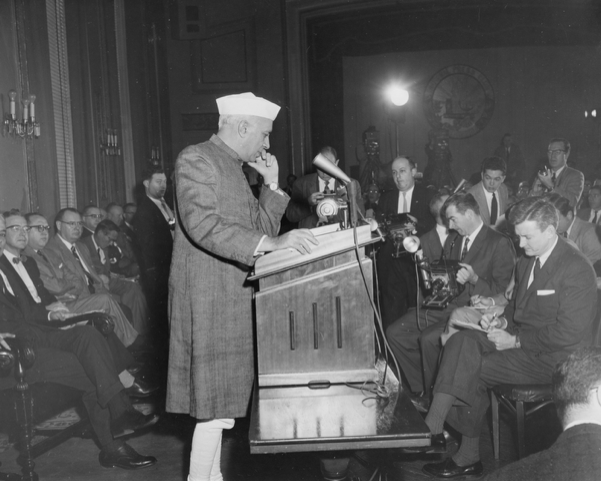
This was the second of three visits Nehru made to the Club during his 16 years as prime minister. The first was in 1949 shortly after he assumed the office and the third was in 1962. He was the first of four generations to talk to the Club – his daughter, Indira Gandhi (1966 and 1971), her son, Rajiv Gandhi (1985), both prime ministers, and Rajiv’s son, Indian opposition leader Rahul Gandhi, who was at the Club on June 1, 2023.