
Chicago mayor describes city 'at war' with administration
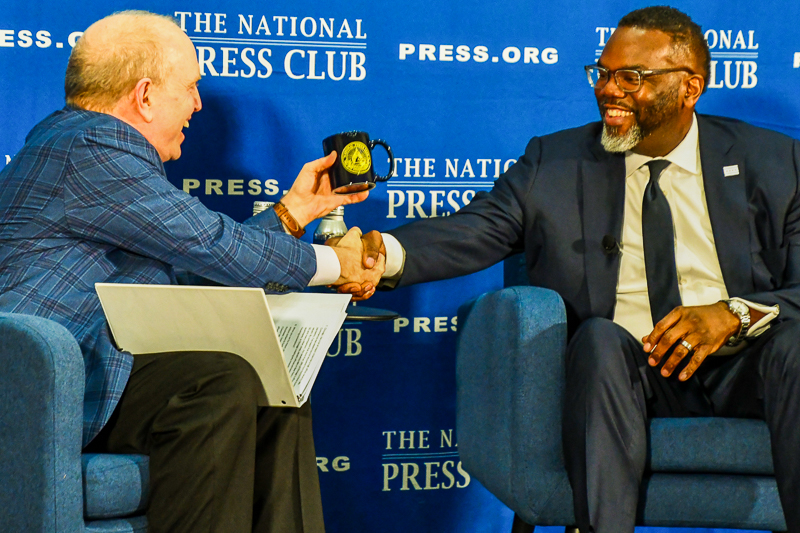
Chicago Mayor Brandon Johnson told a National Press Club audience Wednesday what it’s like “to govern a city in the Trump era, especially in this second Trump term.”
In Washington for the United States Conference of Mayors’ winter meeting, Johnson’s remarks at the NPC Headliner luncheon addressed the “high tension between federal and local governments,” restoring cuts in federal funding for local government and “defending civil liberties in the midst of militarized immigration enforcement.”
“We saw federal agents shoot and kill an unarmed father, an undocumented man named Selverio Villegas-Gonzales who had just dropped off his kids at school,” he said. “He was pulled over by ICE, and as he was trying to pull away, they shot and killed him.” Immigration and Enforcement Customs claimed he was dragging their agent with his car despite contrary video evidence.
“Local governments are challenged in ways that we have never imagined,” he said, praising the Public Rights Project which fosters dialogue among mayors, and provides legal and strategic support to cities.
Johnson suggested the most difficult challenge Chicago and other cities face is “hypermilitarized immigrations raids led by ICE and Border Patrol.” It has two parts: the raids themselves “producing gut-wrenching images of families ripped apart, beloved community members disappearing with no due process” and the protests after the attacks and the federal response with rubber bullets, tear gas and pepper balls, with reporters either caught in the crossfire or explicitly targeted.
Last fall, the Trump administration launched Operation Midway Blitz immigration enforcement in Chicago, sparking protests against Immigration and Customs Enforcement raids.
Johnson leaned on the advice and experience of other mayors like Karen Bass in Los Angele. A common thread is the importance of knowing your legal rights regardless of immigration status. Digital billboards, webinars, teach-ins and pamphlets now inform people, he said.
When President Trump posted an AI image warning Chicagoans they’d soon learn why the Department of Defense was renamed the Department of War, Johnson said, “Essentially, the president of the United States of America used a meme to declare war on an American city. A month later, we had Texas National Guard troops in our city, and we were in federal court to prevent the occupation.
That’s why Chicago is ‘‘at war with the Trump administration” and Johnson’s number one priority remains keeping communities safe. To do that led him to work with the county, state, attorney general, local law enforcement, faith leaders, business leaders, labor unions, and community partners, a cross section of Chicago to present a united front “that firmly rejects the notion that the problem of crime could be solved with a military occupation.” Crime is certainly a major concern, he stressed, but “achieving lasting reductions in violence requires working with local law enforcement and investing in the problems that have clear connections to the root causes of crime.”
Johnson said reducing crime involves investing in youth employment, job fairs, building 10,000 more affordable homes by February 2027, reopening mental health clinics, expanding time off for workers, eliminating the sub-minimum wage, working closely with local police to revamp the detectives bureau to solve more cases, and with community violence intervention groups on some of the city’s most challenging blocks. 2025 ended with a 35% drop in shootings, Johnson said, and the fewest number of homicides in 60 years.
Chicago has filed more than 40 legal actions against the Trump administration, leading to funds restored for policing positions, he said. With the Illinois Attorney General, Chicago is challenging the administration’s “abusive immigration enforcement tactics and repeated rights violations” including racial profiling, lack of due process, indiscriminate use of chemical agents during protests, and their enforcement actions on sensitive locations.” His executive order directed emergency dollars to food pantries and partnered with the city’s faith community to meet the demand after food assistance was cut during the government shutdown.
He issued an executive order establishing “ICE free zones with signage barring ICE and Border Patrol from staging and entering city properties without a judicial warrant. This kept ICE from setting up raids in elementary school parking lots. “This is not about politics. This is about a more fundamental idea that in our country nobody is above the law.”
When asked his reaction to the FBI serving a search warrant at the Fulton County Elections Office in Georgia, Johnson said: “I don’t think it’s a secret that the Trump Administration is absolutely determined to undermine one of the most principled and fundamental values of our democracy, which is a free and fair election.” Another example, he said, “of the administration working to intimidate voters and to ultimately suppress our ability to hold government accountable. Saving our democracy, “is the most patriotic thing we can do…” The civil rights movement and the late Rev. Martin Luther King Jr. serve as models for a well-trained, organized operation to continue the existing resistance in the nation.
A progressive leader, Johnson said if Congress won’t hold this ‘renegade’ administration accountable, “then it will be up to the cities to do it.” “The last thing that any American should do when it comes to securing justice for working people…is surrender. Ultimately, Congress is going to have to act.”
He thanked NPC President Mark Schoeff, Jr., who introduced him, and the Club “for keeping the tradition alive of what real journalism means in this moment: the tradition of investigating the truth and bringing it to the people.”
The discussion’s final question was unexpected: “Is it acceptable to put ketchup on a Chicago hot dog?” The mayor’s answer: “Now that we officially have a pope from Chicago…to put ketchup on a hot dog is officially now a cardinal sin.”